
Estimated reading time: 14 minutes
This article is mainly for the IT/OT and digital platform leaders who decide how the plant’s systems and data fit together. They’re the ones tempted to build in-house with AI, and the ones evaluating UNS, MCP and AI copilots.
Key Takeaways
- AI made code cheaper to write but not cheaper to own.
- Reliable AI needs data with meaning, trust and shape.
- Taxonomies like UNS show where data sits but ontologies show how it connects.
- AI agents should generate governed metadata, not code.
Why Cheap Code Isn’t the Answer
AI can now generate software in minutes. On the factory floor, that speed can optimize production or create problems just as quickly.
In a recent podcast with Francisco Almada Lobo, we talked about how quickly AI is advancing, and why turning it into reliable and lasting value is still so hard. Francisco asked me a hard question: If AI has made code so cheap, why not just build your own software?
This is far from being a new question and my answer hasn’t changed. While AI has made code cheaper to write, it has not made it cheaper to own. Validation, maintenance and future-proofing cost as much as they always did. And the real difference between AI that works and AI that only demos well isn’t the code. It’s the data underneath it.
Writing Code Was Never The Hard Part
AI has given many teams a new confidence to solve their problems by building their own tools. I understand the appeal. But in manufacturing, writing code has never been the real problem. Since the beginning introducing MES starts with a cartography process of understanding all the custom applications made to solve specific customer issues. This has always been the reality.
The real struggle is know-how and escaping from a myopic view of your problems. It’s years of understanding how processes actually work, across plants and across industries. This is why so many startups that enter this space fail. They can write the software with the latest bells and whistles, but they can’t shortcut the knowledge. That’s why the cost of ownership hasn’t moved. You still have to validate what you build not just for today, but for every day in the future and for all the changes your shopfloor will continuously make.
Above all, you have to make sure it fits into a bigger digital transformation journey instead of becoming another silo that solves one narrow problem. Building an app is one thing. Building a system that supports digital transformation across an entire plant is something else.
AI Accelerates Plant Fragmentation
AI makes building apps easier, but it doesn’t make connecting them across an entire plant any easier. If anything, it gives you more to connect. I’ve seen what happens when that difference is ignored. Years ago, I went to assess a customer’s plant for an MES project, and every area I walked into had its own app, and all of them had a valid reason to exist: one for injection molding, one for painting, one for electronics. This was back when everything was still coded by hand.
Every stakeholder we interviewed proudly showed us their tool, convinced we’d never beat it. Each app worked fine on its own. Put together, they didn’t add up to a system. Back then, every one of those apps took months of hand-coding, and that effort alone kept the number of silos in check.
AI removes that brake. Today, any engineer can build a working app in days, so every line, every step and every team can have its own. Left unchecked, AI doesn’t fix plant fragmentation. It accelerates it.
READ MORE: How TDK Electronics Scaled Digital Transformation Across 20 Factories
What Does AI Need to Make Good Decisions?
If writing code was never the hard part, neither is the AI model. What makes AI reliable in a factory is the data it reasons over, and specifically three things.
1. Meaning
AI has to know what your data represents and how it connects. It needs to know which material went into which product, for which order, on which line. Without a shared model of the plant, every system speaks its own language and AI is left translating.
2. Trust
The data has to reflect reality. That means it has been validated against rules and constraints before it’s accepted, not just collected. AI working on unvalidated data gives you fast answers, but not right ones.
3. Shape
The data has to be ready for the questions AI will ask, prepared outside the systems that run production and pre-aggregated where you already know what’s needed. Otherwise AI spends its time, and your money, working out where things are instead of answering.
Why Most AI Tools Will Hit a Wall
Here’s the part people miss. The know-how that makes manufacturing so hard is exactly what a governed data model captures. Years of understanding how a plant works are encoded in its structure, rules and relationships. That’s what separates reliable AI from an impressive demo.
Without that structure, you end up in what I call the Tower of Babel: a thousand applications and a thousand interfaces. You can write code to paper over the gaps, but every interface forces your AI to make another leap. A different structure, a different way to query, a different meaning for the same word. It adds up fast.
It adds up in cost too. Token prices will become a serious topic. Every token AI spends working out where the data lives and how it connects is a token it isn’t spending on an answer. It also makes it impossible to work with smaller local models, it forces you to use frontier models on every prompt to brute force a solution.
That’s why I’m skeptical of many of the analytics copilots we’ve seen over the past year. Plenty of them run on synthetic data, and some vendors are raising big valuations because a polished demo is easy to love. My prediction is that most will hit a wall in the next, agentic phase. They don’t control the data they run on, and they aren’t in a position to enforce control over shop floor applications, or even to interface with them properly.
So the question that matters isn’t who owns the data. It’s who owns the structure that defines what the data means and how it connects.
READ MORE: Why AI pilots are Stalling and What Manufacturing Leaders are Getting Wrong
From Taxonomy to Ontology
My advice would be to start with meaning, not access. Before AI can reason over your data, that data needs an ontology. A model of what things are and how they relate. Then it needs to be shaped for the questions AI will ask.
The Unified Namespace (UNS) has attracted a lot of hype lately, especially among companies early in their digitalization journey. It organizes your data around an ISA-95 taxonomy, and monitoring and dashboards become much easier.
For early-stage plants, that’s a genuine quick win. It works well for narrow use cases, such as comparing machines of the same model. But a taxonomy only tells you where a sensor sits. It doesn’t tell you how the raw material in that machine relates to the product, the production order or the flow you’re running right now.
Anyone on the shop floor understands those relationships instinctively. Show a line manager a plant layout and ask if it’s enough to understand the factory, and they’ll say no. The real factory is far more complex than any drawing, and that complexity lives in the connections a taxonomy leaves out.
UNS gives you surface data in a more structured form, but it enforces no control. Each data point is still an event in time that doesn’t really connect to anything. Don’t get me wrong, it’s an improvement to putting sensors everywhere and letting it all work by magic.
An MES works differently by design. It has to map reality, so it enforces an opinionated ontology with constraints and strong relationships. Anything inside it has passed so many validations that we know it’s right. That’s the context AI needs.
READ MORE: The Context Layer That AI Needs
AI Needs a Shared Language
Even inside one company, systems don’t speak the same language. When we arrive at a customer, the ERP team and the MES team already use different terms for the same things. So the first thing we do is define a shared semantic, what the MES means by a “material” and what the ERP means by a “product.”
AI needs that even more than people do, because it has no context about your organization. That’s why simply connecting the Model Context Protocol (MCP) to every system and letting AI figure it out doesn’t scale.
It makes for impressive demos, but each system brings its own meaning, and a single plant produces terabytes of data. Interfaces like MCP will be part of the future, but they need to deliver meaning, not just database queries.
Why Does Governed Data Matter More Than Code for AI
Because AI is only as reliable as the data it reasons over. When that data is governed and trustworthy, AI can turn it into meaningful insights. This means the systems that have traditionally been the hardest to analyze could soon become the easiest.
Those systems were built around control; but making sure every piece of data reflects reality often meant analytics took a back seat. Home-grown applications and analytics tools filled that gap and made data easy to visualize. They delivered insights quickly, but the data underneath wasn’t always reliable.
AI Is Only as Good as Its Context
AI is not magic. It’s a semantic inference mechanism. It works out meaning from the context it’s given. A well-defined ontology, backed by enforced rules and constraints, provides that context, so AI can generate reliable answers, dashboards and reports quickly. A landscape of a thousand disconnected interfaces gives it nothing to anchor to, so it guesses.
I once watched a vendor demo where AI was asked for an OEE figure and tried to calculate it live. It looked up how OEE is calculated, pulled raw data from the database and worked it out on the spot. It was slow and would never be right, because every company defines OEE its own way. When the definitions and aggregations already exist in a governed model, AI doesn’t have to guess. It builds on what’s already there. It won’t try to understand what are Nelson rules, what it means to ask for Fist Pass Yield all of these concepts are already in-built in the system.
That’s the real lesson for anyone weighing cheap code against governed data. The investment in structure isn’t overhead. It’s what makes AI usable. So before asking what AI can do with your data, ask whether your data enforces meaning. If it does, AI is a powerful accelerator that closes gaps you’ve lived with for years. If it doesn’t, no model will fix that for you.
From Analytics Gap to AI Accelerator

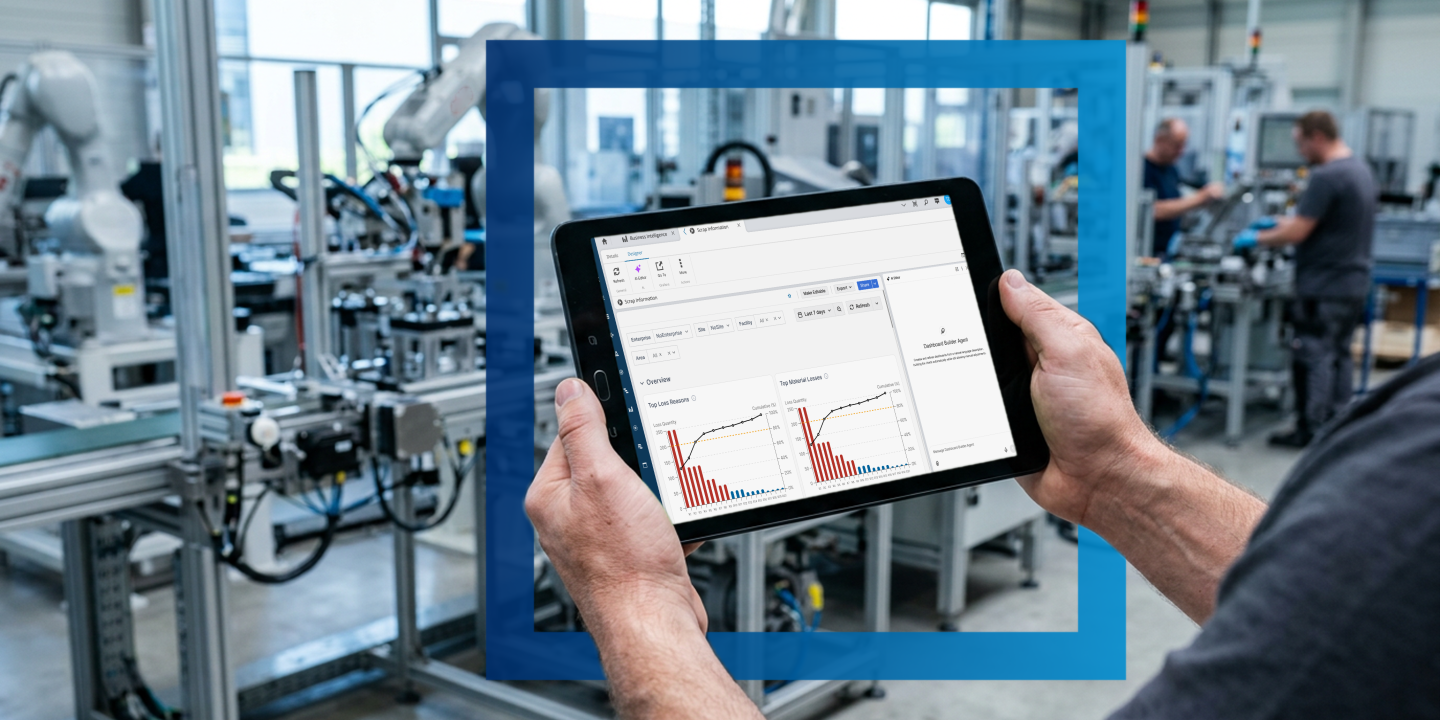
When you have this structure it’s easy to move on to the next phase. With purpose-built AI agents, we can turn all our designer and low code engines to a conversation. An engineer can describe the dashboard or UI page they need in plain language, without waiting in an IT backlog. We leverage what is great about AI building code, with the advantage of guard railed and transparent low code interface. The agent checks what already exists, including widgets, data sources and objects in the Canonical Data Model, and generates governed metadata, not code.
That difference matters. The result runs on the same engine as anything built by hand, so it can be versioned, validated and kept up to date through every upgrade. No hidden technical debt and no orphaned scripts. The user stays in control and can keep refining it in conversation or switch to manual editing at any time.
That’s the opposite of vibe coding. The AI doesn’t invent a structure. It works inside one, and that’s what brings safety, transparency, versioning and the ability to iterate. For teams already using the platform, building with AI isn’t a new tool to adopt. It’s the obvious next step.
SEE MORE: AI Purpose-Built Agents – Data Sheet
What Will it Take to Run AI Agents on the Shop Floor?
A deterministic, constrained system underneath. AI Agents will come to manufacturing, and I believe in them, but only when AI is choosing from rules it can’t break.
Every problem above, from token costs to response times, becomes a problem on steroids once you move to agents. The answer isn’t to make everything deterministic but it’s to let a probabilistic engine work inside a system strict enough that you can trust its choices.
Take a simple example. You want AI to change a machine’s state to “down.” What does “down” mean? Are you following SEMI E10 or SEMI E58? Does your system enforce that? When the system already defines the possible answers, AI isn’t making up an answer. It’s choosing the right one from a set of valid ones. That’s how we’ll get AI onto the shop floor.
I’m still on the fence about whether shop floor AI will run on frontier models or on local models good enough to manage token costs. It comes down to cost per token and fit for purpose. If a use case only works with the most powerful model available, it probably isn’t well designed.
The likely reality is a hybrid. A frontier model does the reasoning and orchestrates smaller local models that handle the work closer to the line. My hope is that local models get good enough that most tasks won’t need a round trip to the cloud at all.
So will we reach the point where a production engineer simply describes what they want and the system reshapes itself in production? That’s the old promise of make-to-order, applied to software. I think we’ll get there, but not yet. Over the next three to five years, those use cases will start to appear.
Don’t Wait for AI to Mature
AI will keep changing faster than any roadmap can predict. Manufacturing has a habit of waiting for technology to mature, letting others go through the revisions before committing. With AI, that’s the wrong approach. The gap between what AI can do and what manufacturers actually capture is already wide, and waiting only makes it wider.
But moving fast doesn’t mean building fast. Cheap code will give you more apps, more silos and more impressive demos. Governed data will give you AI you can trust. Start by understanding what your data means, make sure it reflects reality, and shape it for the questions you want answered.
Then put AI to work inside that structure, test it against real use cases and adjust as the technology evolves. The companies that win won’t be the ones writing the most code. They’ll be the ones whose data AI can actually understand.
Listen to the Podcast →
FAQ
Vibe coding means building software by prompting an AI and accepting the code it writes, often without fully reviewing it. It’s fast for prototypes, but risky for production systems. The code can be hard to validate, maintain and integrate, which creates hidden technical debt. In manufacturing, governed approaches that generate versioned metadata are safer.
Governed data is data managed by clear rules. It has a defined meaning and enforced validations, and changes to it are controlled and traceable. In manufacturing, every record is checked against how the plant actually works before it’s accepted. That makes it trustworthy, consistent and reliable for AI to reason over.
A taxonomy classifies data into a hierarchy, showing where things sit, like a sensor on a line. An ontology defines how things relate, connecting materials, products, orders and production flows.
A Unified Namespace (UNS) organizes data into a consistent taxonomy, which is a quick win for monitoring and dashboards. But it doesn’t define how materials, products, orders and processes relate, or enforce any control. AI needs that ontology and validated context to produce reliable insights.
AI analytics copilots struggle in manufacturing because they rarely control the data they run on. Many are demoed on synthetic data, then meet real plants full of disconnected systems with conflicting definitions and no shared model. Without governed context, they spend time and tokens guessing where data lives and what it means, producing slow or unreliable answers.
AI builds reliable manufacturing dashboards when it works inside a governed data model instead of writing new code. Purpose-built agents use the existing data sources, definitions and widgets, then generate versioned metadata that runs on the same engine as manual builds. The results stay consistent, validated and upgrade-safe.